The step from conducting initial research to commercialization can seem daunting, but your university’s Technology Transfer Office has the resources and support to protect your intellectual property. Intellectual property, or IP, can refer to a multitude of creations such as inventions, key research findings, literary/artistic works, designs, symbols, names, and images. Legally protecting your intellectual property can protect future financial opportunities and determine usage rights for others. If you are a university based team in an I-Corps program, you should consider contacting your Technology Transfer Office and ensuring your intellectual property is legally protected.
A look into your university’s TTO (Technology Transfer Office)
Most universities have their own Technology Transfer Office (TTO) to provide support for early-stage commercialization.
You can also contact your university’s TTO for a number of situations:
- Technology is in the initial stages
- Federal funding (must disclose)
- Don’t have a prototype yet
- Going to publish a paper
- Presenting in a conference
- Technology has multiple applications, but no interest in commercializing it
- Going to collaborate with an industry partner
The first step of working with the Technology Transfer Office is to submit the initial disclosure statement. The disclosure helps the Technology Transfer Office gain some introduction to your research work and to generate questions about your intellectual property, such as: What is the observable/anticipated value of the IP? What is the IP literature/landscape? Any potential freedom to operate (FTO) issues? These answers to these questions help the TTO guide the early-stage commercialization process, as they review and screen invention disclosures. This information can also assist the TTO in providing you with IP education and resources.
The TTO has to be strategic about their us of budget for IP protection, and this information can help them make a case for these costs.
If the IP is protected, you may continue to be part of the conversation between the TTO and industry partners who are interested in using your innovation (i.e. licensing).
—
Types of Protection for Intellectual Property
With multiple types of intellectual property protection, consulting your TTO can help determine which option works best for your research and future commercialization goals.
Patents
This form of intellectual property enables a patent holder the right to exclude others from making, using, importing, and selling the invention throughout the U.S. for a limited period of time. If you are a university employee and created the invention as part of your employment, the university will own the patent. Patents are issued through the USPTO (U.S. Patent and Trademark Office).
Trademarks
Trademarks are also issued by the USPTO and are legal instruments represented as words, phrases, symbols or designs, or a combination that identifies and distinguishes the source of the goods of one party from those of another. They are issued for ten years, but can be renewed. Trademarks can be similar to another company’s trademark; however, the products must exist within different industries.
Trade Secrets
Trade secrets are commercially valuable and are simply the legal term for “confidential” business or technical information. Your TTO can also determine if this is the best decision to pursue from a legal standpoint.
Copyright
Copyright is a legal instrument giving the creator of an original work (literary, artistic) exclusive rights to it, usually for a limited time. This also includes software or computer code. Generally, it is “the right to copy”, but it also gives the copyright holder the right to be credited for the work, to determine who may adapt the work to other forms, who may perform the work, who may financially benefit from it, and other related rights. Copyrights are issued through the U.S. Copyright Office in the Library of Congress and begin automatically when the original work is created. There are many caveats when it comes to copyright, so the TTO can provide crucial information and helpful guidance in registering copyright.
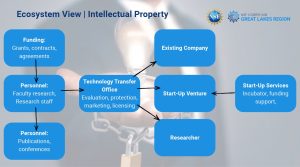
This ecosystem chart visualizes the movement of research IP. After research, personnel disclose their inventions to the Technology Transfer Office. The TTO can then distribute the technology to existing companies, start-up ventures, and other researchers. Additional services, such as incubators and other funding, can help support start-up ventures.
Myths of Technology Transfer Offices
A few common misconceptions about the TTO can prevent people from visiting, such as:
- My university does not own the IP of my tech; I developed it in my spare time in my lab.
- I need to have a fully developed idea before submitting a disclosure.
- You rejected my disclosure, so you rejected my research.
- The decision is taking too long.
These factors or outcomes are simply myths and should not prevent you from consulting the TTO or doubting the validity or importance of your research. Technology Transfer Offices offer incredible resources, especially for I-Corps teams, to protect your intellectual property and continue on the path to commercialization.
For more information on IP and Technology Transfer Offices, view our full video series:
https://youtube.com/playlist?list=PLHL2D9Bq5JlxcndG9ODcn0Hb3LXjyEpQ2&si=1LH7xSXl_ACo_WBz
Blog by Melena Barth
Intellectual Property and Technology Transfer Office research by Joy Eakin and Joe Bradley.
NSF I-Corps Hub: Great Lakes Region, 2026


